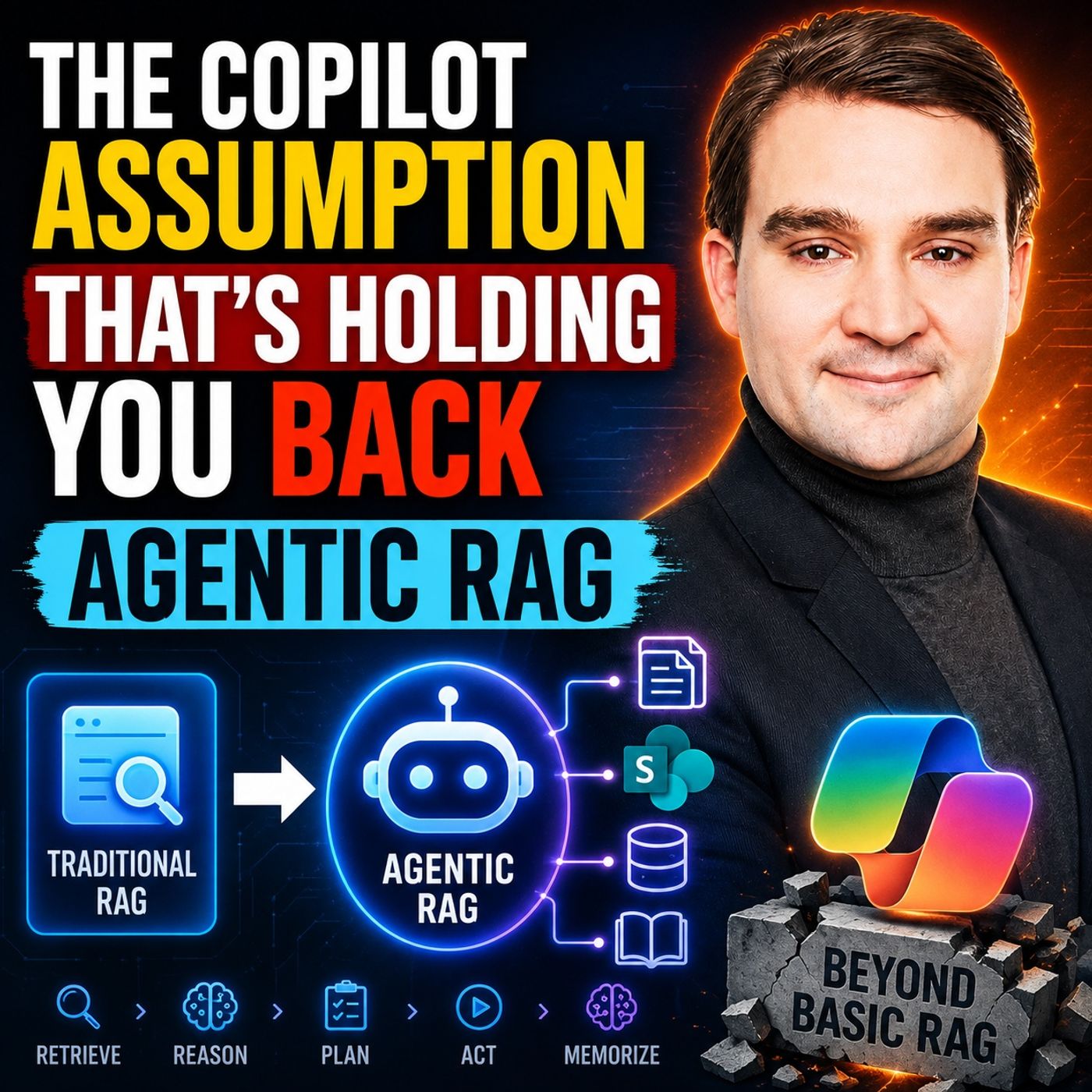
The Copilot Assumption That's Holding You Back — Agentic RAG
Mirko Peters - Founder of m365.fm, m365.show an... · 49:58 · 2,642 plays
From the album M365.FM - Modern work, security, and productivity with Microsoft 365
Description
Most people still think Microsoft Copilot is fundamentally a question-and-answer system: you ask something, it searches for information, and an LLM generates an answer. But that mental model is becoming outdated. Copilot is evolving toward an orchestration system that can determine where to search, evaluate what it finds, decide whether additional information is required, and increasingly take action based on the result. In this deep dive, we break down Agentic RAG, how it differs from traditional Retrieval-Augmented Generation, why multi-source enterprise questions expose the limits of single-shot retrieval, and what this architectural shift means for Microsoft 365, Copilot Studio, Microsoft Graph, Entra, Purview, MCP, governance, and enterprise AI strategy.WHY TRADITIONAL RAG WORKS — UNTIL IT DOESN'TTraditional Retrieval-Augmented Generation follows a relatively straightforward pipeline. A user's question is converted into an embedding, relevant chunks are retrieved from a vector database, those chunks are placed into the model's context, and the LLM generates an answer. For straightforward questions such as finding a policy or locating a specific piece of information, this architecture can be fast, inexpensive, and highly effective. The limitation appears when the answer is distributed across multiple systems. Understanding why an invoice increased, for example, might require the current invoice, the previous invoice, usage information, and contractual pricing conditions. A single retrieval against one source cannot necessarily assemble that complete picture.WHAT AGENTIC RAG ACTUALLY CHANGESAgentic RAG changes the role of the language model. Instead of using the LLM only at the end of the retrieval pipeline to generate an answer, the model participates in deciding what information is required and how to obtain it. The episode explores the ReAct pattern — Reason, Act, Reason, Act. The system analyzes a problem, performs a retrieval or tool call, evaluates the result, and decides whether another action is necess
More By Mirko Peters - Founder of m365.fm, m365.show an...
- 1

Dynamics 365 Contact Center - Simply Explained
Mirko Peters - Founder of m365.fm, m365.show an... · 9,637 plays · 20:21
- 2
Beyond Copilot: Building AI That Works in the Real World with Azure AI Foundry and Agentic AI for Frontline Workers with Fergus Kidd [MVP]
Mirko Peters - Founder of m365.fm, m365.show an... · 12,119 plays · 60:28
- 3
Dynamics 365 Customer Insights Journeys - Simply Explained
Mirko Peters - Founder of m365.fm, m365.show an... · 7,454 plays · 20:12
- 4
Microsoft Entra Domain Services - Simply Explained
Mirko Peters - Founder of m365.fm, m365.show an... · 9,057 plays · 18:11
- 5
AlbumM365.FM - Modern work, security, and productivity with Microsoft 365
Mirko Peters - Founder of m365.fm, m365.show an... · 4,164 plays
- 6
Your Copilot Has No Memory — Why RAG Fails and LLM Wiki Fixes It
Mirko Peters - Founder of m365.fm, m365.show an... · 3,092 plays · 54:58
- 7
PowerPoint Like a Pro- Hidden Features, Corporate Templates & Copilot with Fiona Walsh [MVP]
Mirko Peters - Founder of m365.fm, m365.show an... · 7,074 plays · 62:21
- 8
Power Platform Governance Without Killing Innovation: Security, DLP, Environments & Citizen Development with Michael Roth [MVP]
Mirko Peters - Founder of m365.fm, m365.show an... · 10,497 plays · 63:15
- 9
Microsoft Cloud PKI - Simply Explained
Mirko Peters - Founder of m365.fm, m365.show an... · 9,146 plays · 18:44
- 10
From Demo to Production- Building Enterprise AI Agents That Actually Work with Microsoft Copilot Studio with Elliot Margot [MVP]
Mirko Peters - Founder of m365.fm, m365.show an... · 1,740 plays · 64:55
You May Also Like
- 1
AlbumHer Outlaw Highlander: A Steamy Second Chance Bad Boy Returns Medieval Scottish Historical Romance
8,948 plays
- 2
AlbumGhosts Of America 17 - The House My Sister Rented
6,015 plays
- 3
AlbumCool Rides on Wheels: Electric Race Cars, Superbikes, and More: Cool Rides
349 plays
- 4
AlbumParker
8,207 plays
- 5
AlbumMy Forever Heartache: Four Years of Discovery with the Kalahari Bushmen: A millionaire gives it all up to live with the Bushmen
2,330 plays
- 6
AlbumIGARASHI KANTA Radio
6,235 plays
- 7
AlbumGospel First Nation
7,150 plays
- 8
Album6IXMANE Radio
1,650 plays
- 9
AlbumFergus Radio
8,367 plays
- 10
AlbumBob Gallion Radio
4,883 plays
- 11
AlbumThe Driver Book-I Decision
9,776 plays
- 12
AlbumJesse Colin Young
7,206 plays