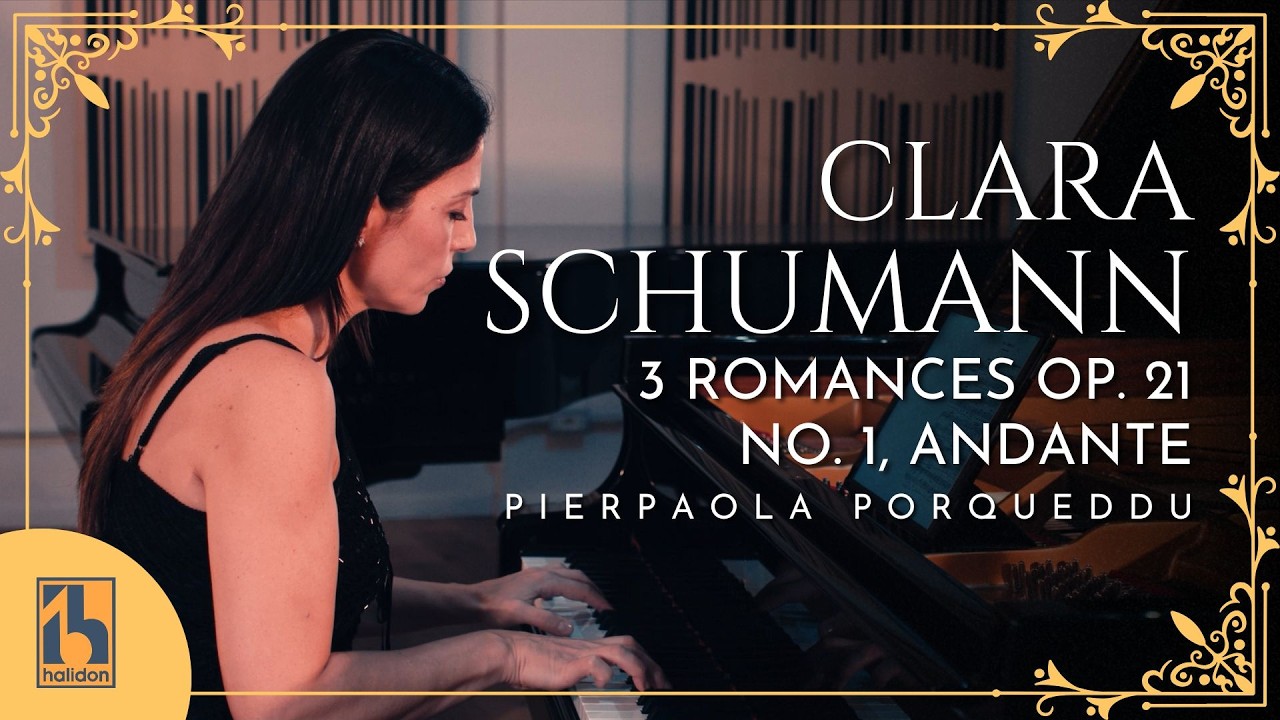
Clara Schumann: 3 Romances Op. 21 No. 1, Andante | Pierpaola Porqueddu
5:42 · 71,853 پلے
البم سے Royal Music
تفصیل
🎶Discover the full album "Music of the Heart" on Youtube: https://youtu.be/XGONQBI2Hdo 🎧Find it on all major platforms: https://bfan.link/music-of-the-heart 🎵Stream the track on all major platforms: https://bfan.link/schumann-3romances-op21-no1-andante Clara Schumann: 3 Romances Op. 21 No. 1, Andante Performed by Pierpaola Porqueddu 3 Romances Op. 21 No. 1, Andante Fanny Mendelssohn’s Nocturne, H. 337 is a jewel of intimate piano composition: gentle, lyrical, and reflective. A flowing accompaniment supports the tenderness of the melody, which unfolds like late-night thought — glowing and soft, but also bittersweet, succeeding in expressing the complexity of experience. It’s the kind of piece that doesn’t rush ahead, but lingers invitingly. All we can do is listen closely to every nuance and breath. Clara Schumann Clara Schumann (1819–1896) was a German pianist and composer widely regarded as one of the greatest performers of the 19th century. She began touring publicly as a child in Leipzig, trained by her father Friedrich Wieck, and had already built an international reputation before she turned twenty. As a performer she was genuinely transformative, helping to establish the modern model of the solo recital — serious repertoire, played from memory, with interpretive depth over virtuosic display. Yet her story is also one of structural friction. Her marriage to Robert Schumann brought both creative partnership and practical constraint: she continued to perform and compose while raising eight children and, increasingly, managing the household's finances as Robert's health declined. After his death in 1856, concert performance became her primary livelihood — a decades-long touring career that was almost unprecedented for a woman of her time. Composition, which she had practised seriously since childhood, became harder to defend and sustain. She often expressed doubt about her right to compose at all, internalising a cultural message that it was a male domain. Much of her output — piano pieces, songs, a piano co
آپ کو یہ بھی پسند آ سکتے ہیں
- 1

البمKeep True
Keep True · 698 پلے
- 2
البمSecret Trillionaire
2,442 پلے
- 3
البمMy Big TOE by Thomas Campbell - Unifying Mind and Matter
Thomas Campbell together with the MBT Volunteer... · 9,426 پلے
- 4
البمRaheeq
Raheeq · 4,112 پلے
- 5
البمLa Ultima Cena 2002
Risas Rock · 11,039 پلے
- 6
البمKayfabe
Euro Edrick · 3,963 پلے
- 7
البمTHE REAL DE RANCÉ: ILLUSTRIOUS PENITENT AND REFORMER OF NOTRE DAME DE LA TRAPPE
8,089 پلے
- 8
البمThe Stranglers
The Stranglers · 1,395 پلے
- 9
البمHighway To Hello
Neoangin · 8,099 پلے
- 10
البمAmerica
America · 174 پلے
- 11
البمLoyalty Over Designer
EarleDivine · 8,995 پلے
- 12
البمsafi
safi · 6,205 پلے