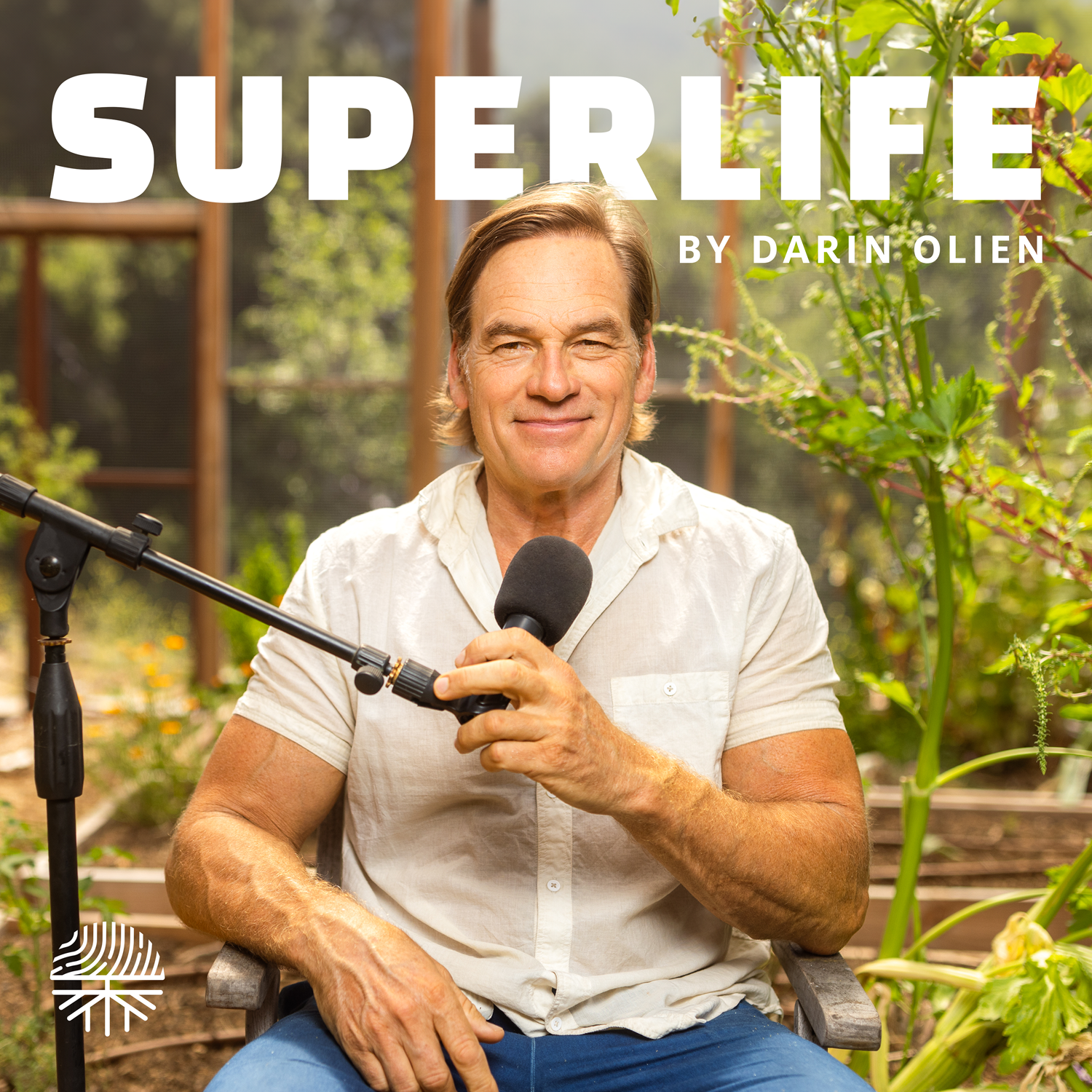
Your Brain in the Wild: Why Nature Is Essential for Your Nervous System
Darin Olien... · 16:50 · 6,762 plays
From the album SuperLife with Darin Olien
Description
What if spending time in nature isn't simply good for you, but something your brain is biologically designed to need? In this solo episode, Darin explores the sensory neuroscience of nature and the growing research suggesting that our increasingly indoor lives may be fundamentally mismatched with the environments our brains and nervous systems evolved to experience. From walls and screens to fluorescent lights, traffic, right angles, and constant notifications, modern environments bombard us with sensory inputs our ancestors never encountered at this scale. The numbers put that mismatch into perspective. Darin highlights research suggesting the average American spends roughly 87% of life indoors and another 6% inside vehicles. In other words, we've effectively become an indoor species living inside outdoor-evolved bodies, brains, eyes, and nervous systems. Darin breaks down why this isn't merely another reminder to "go outside." He explores how modern environments place continuous demands on executive attention, why sustained attention can eventually give way to rumination and mental chatter, and what more than 100 brain-imaging studies may reveal about what happens when we finally return our brains to natural environments. This episode ultimately asks a surprisingly important question: What if nature isn't a luxury or lifestyle preference, but a biological input we've slowly removed from our lives? What You'll Learn Why your brain evolved for branches, coastlines, clouds, mountains, and irregular natural geometry instead of straight lines How much of the average American's life is now spent indoors or inside vehicles Why Darin describes modern life as an evolutionary mismatch for the nervous system How artificial environments continually demand processing from your executive attention system Why sustained directed attention can eventually lead to fatigue, rumination, and mental chatter How light, sound, movement, visual patterns, and circadian cues shaped the human nervous system Why simply telling people to "go
More By Darin Olien...
- 1

My Exact Daily Routine for Energy, Longevity & Optimal Health
Darin Olien... · 7,732 plays · 28:45
- 2
Why You Should Only Check Your Health Data Once a Week
Darin Olien... · 3,607 plays · 24:06
- 3
Dr. Shefali: Why Modern Parenting Is Failing (And What to Do Instead)
Darin Olien... · 7,869 plays · 69:48
- 4
Escaping Comfort: Why Risking Rejection is the Key to a Super Life
Darin Olien... · 4,551 plays · 19:02
- 5
Leon Aryah Lewis: Why You Can't Run From Your Shadow Self—Unlocking the Hidden Power of Your Soul
Darin Olien... · 2,036 plays · 73:36
- 6
William Gaunitz: The Truth About Hair Loss, Regrowth & Why Most Treatments Fail
Darin Olien... · 5,553 plays · 68:51
- 7
Forever Chemicals: The 60-Year PFAS Cover-Up Hiding in Your Drinking Water
Darin Olien... · 7,778 plays · 21:31
- 8
Maria Bertrand: How Rescuing a Baby Sparrow Changed My Life Forever
Darin Olien... · 4,554 plays · 74:40
- 9
Brandon Jenner: What Becoming a Father Forced Me to Finally Face About My Childhood
Darin Olien... · 8,182 plays · 73:33
- 10
The Most Ignored Muscle in Your Body Could Be Affecting Your Sleep, Breathing & Health
Darin Olien... · 7,322 plays · 25:07
You May Also Like
- 1
AlbumReverend Beat-Man Radio
9,639 plays
- 2
AlbumKilled, Framed, & Butchered: The Terrifying Reality of Nigerian Police Brutality
523 plays
- 3
AlbumMMARC
MMARC · 4,360 plays
- 4
AlbumNation Haven Radio
Nation Haven · 4,995 plays
- 5
AlbumKNAPP FILMS
6,453 plays
- 6
AlbumCYD JOSH
8,765 plays
- 7
AlbumFamous Pluto
11,311,933 plays
- 8
AlbumMadumane
6,802 plays
- 9
Albumjulian solo indajaus
julian solo indajaus · 8,429 plays
- 10
AlbumA Mad And Faithful Telling
DeVotchKa · 8,279 plays
- 11
AlbumRain Falls
Madego · 4,154 plays
- 12
AlbumCheikh Senegood
174 plays