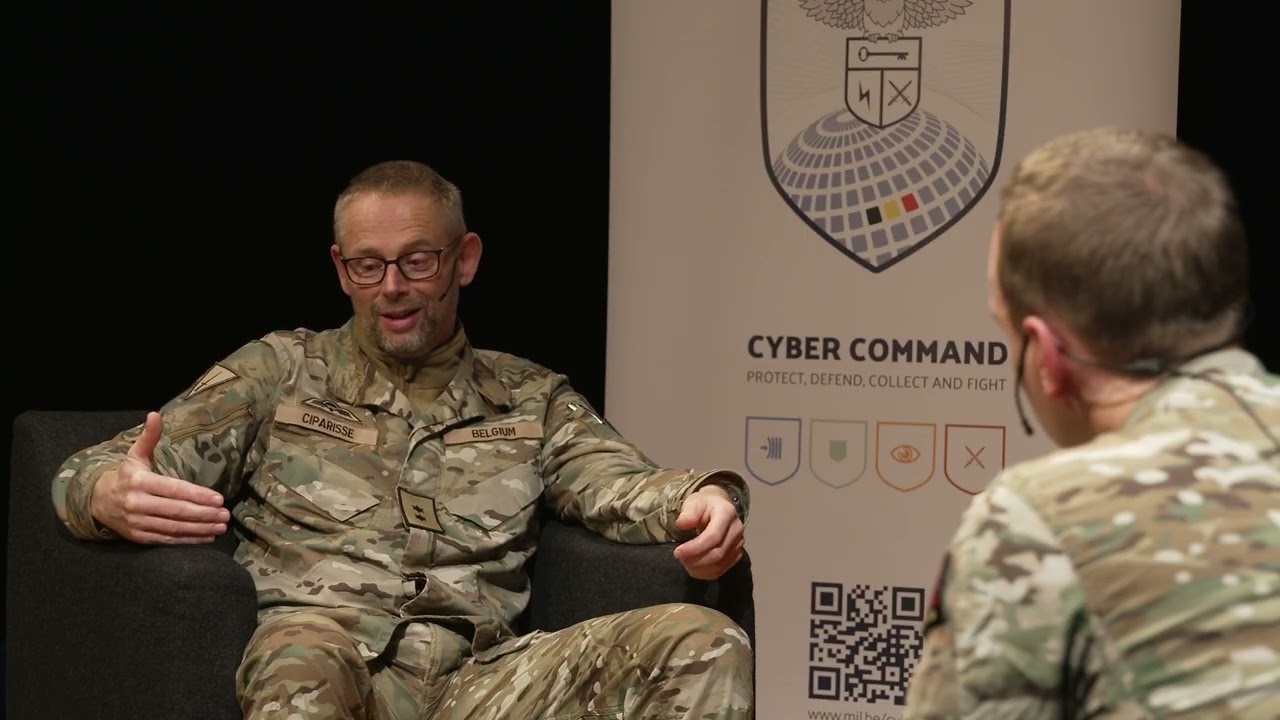
Understanding Hybrid Threats: insights from the Belgian Cyber Force Commander
43:49 · 3,314 plays
From the album Irregular Warfare Initiative
Description
In this IWI Project Europe Fireside Chat, we explore Belgium’s perspective on hybrid warfare, with a focus on cyber-attacks and information warfare. Our guest is Major-General Pierre Ciparisse, appointed in September as Commander of the Belgian Cyber Force and head of the Belgian Cyber Command within the Belgian Military Intelligence Services—responsible for addressing the full spectrum of cyber-related challenges. We begin by unpacking how General Ciparisse defines hybrid threats and why ambiguity (difficult attribution) and asymmetry (high defensive burden) are their defining characteristics. We also discuss whether hybrid warfare is “old wine in new bottles,” tracing historical parallels while examining how cyberspace—across its physical, logical, and cognitive layers—has transformed scale, speed, and reach. From there, the conversation turns to technology as an enabler, with a close look at how artificial intelligence is accelerating both information operations and cybercrime—while also offering real defensive promise if institutions can keep pace through talent and analytical investment. General Ciparisse then outlines the current threat landscape: the reuse and adaptation of tools driving an overall acceleration in cyber-attacks and disinformation campaigns, the role of multiple state and non-state actors, and the risks posed by coordinated, multi-vector attacks against critical infrastructure. We also map Belgium’s cyber ecosystem and crisis-response architecture, including the division of responsibilities across national actors and the importance of strategic communication in countering disinformation. A key theme throughout is resilience through collaboration—captured in his blunt maxim: “It takes a network to defeat a network.” Finally, we examine how cyber forces integrate into broader military campaigns below the threshold of armed conflict, drawing lessons from Ukraine on synchronization with conventional operations, operational constraints, and what cyber can (and cannot) decide in modern war.
You May Also Like
- 1

AlbumLa Nueva Quimica
La Nueva Quimica · 698 plays
- 2
AlbumCon (2020 Mix)
Alai · 6,866 plays
- 3
AlbumFait & Bonavita Radio
7,786 plays
- 4
AlbumValter
Valter · 6,526 plays
- 5
AlbumImprove Your Memory: How to gain more clarity, retain knowledge and obtain mental mastery
7,696 plays
- 6
Album1975 Retro Funk
Hyperbolic Vibe · 872 plays
- 7
AlbumTetz & Lee
Tetz & Lee · 5,906 plays
- 8
AlbumTrinity Soulja
Trinity Soulja · 8,817 plays
- 9
AlbumRoberto Orellana
Roberto Orellana · 3,221 plays
- 10
AlbumSojourner
Immortal Girlfriend · 3,493 plays
- 11
AlbumSideroom Ghost
Sideroom Ghost · 9,769 plays
- 12
AlbumHours I Wish I Could Rewrite
Grey Ether · 523 plays