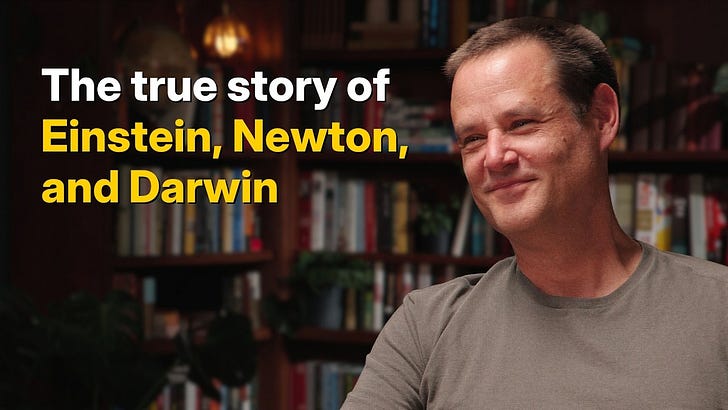
Michael Nielsen – How science actually progresses
Dwarkesh Patel... · 123:03 · 4,695 plays
From the album Dwarkesh Podcast
Description
The key question in this conversation is, how do we recognize scientific progress?It's especially relevant for closing the RL verification for scientific discovery. But it’s also a surprisingly mysterious and elusive question when you analyze the history of human science.We approach this question through the stories of Einstein (who claimed that he hadn't even heard of the famous Michaelson Morely experiment which is supposed to have motivated special relativity until after he had come up with it), Darwin (why did it take till 1859 to lay out an idea whose essence every farmer since antiquity must have observed?, Prout (how do you recognize that isotopes exist if you cannot chemically separate them?), and many others.The verification loop on scientific ideas is often extremely long and weirdly hostile. Ancient Athenians dismissed Aristarchus's heliocentrism in the 2nd century BC because it would imply that the stars should shift in the sky as the Earth orbits the sun. The first successful measurement of stellar parallax was in 1838. That's a 2,000-year verification loop.But clearly human science is able to make progress faster than raw experimental falsification/verification would imply, and in cases where experiments are very ambiguous. How?Michael has some very deep and provocative hypotheses about the nature of progress. One I found especially thought-provoking is that aliens will likely have a VERY different science + tech stack that us. Which contradicts the common sense picture of a linear tech tree that I was assuming. And has some interesting implications about how future civilizations might trade and cooperate with each other.So many other interesting ideas. Really hope you enjoy this as much as I did.Sponsors* Labelbox researchers built a new safety benchmark. Why? Well, current safety benchmarks claim that attacks on top models are successful only a few percent of the time, but the prompts in those benchmarks don’t reflect how real bad actors actually write. You can read Labelbox’s research here: https
More By Dwarkesh Patel...
- 1

AlbumDwarkesh Podcast
Dwarkesh Patel... · 9,708 plays
- 2
Terence Tao – Kepler, Newton, and the true nature of mathematical discovery
Dwarkesh Patel... · 3,613 plays · 83:44
- 3
Reiner Pope – Chip design from the bottom up
Dwarkesh Patel... · 6,765 plays · 80:30
- 4
Adam Marblestone — AI is missing something fundamental about the brain
Dwarkesh Patel... · 5,655 plays · 109:53
- 5
The next big breakthrough will be AIs learning on the job
Dwarkesh Patel... · 6,587 plays · 19:53
- 6
Grant Sanderson – AI and the future of math
Dwarkesh Patel... · 3,813 plays · 93:39
- 7
Dario Amodei — "We are near the end of the exponential"
Dwarkesh Patel... · 5,792 plays · 142:20
- 8
The most important question nobody's asking about AI
Dwarkesh Patel... · 7,136 plays · 24:38
- 9
David Reich – Why the Bronze Age was an inflection point in human evolution
Dwarkesh Patel... · 4,520 plays · 133:20
- 10
Jensen Huang – TPU competition, why we should sell chips to China, & Nvidia’s supply chain moat
Dwarkesh Patel... · 6,824 plays · 103:12
You May Also Like
- 1
AlbumFree Selection
Free Selection · 4,242 plays
- 2
AlbumImpassioned
BUMP! · 3,193 plays
- 3
AlbumIsolara
Isolara · 10,639 plays
- 4
AlbumMeet Mr. Blonde
Mr. Blonde · 5,105 plays
- 5
AlbumDo Some Work
DJ Cable · 8,638 plays
- 6
AlbumMedieval Metal Workout • Instrumental Music for Workout & Gaming
Hitron Music · 6,445 plays
- 7
AlbumThe Durban
The Durban · 3,533 plays
- 8
AlbumMbuzi
Young Lunya · 19,707 plays
- 9
AlbumTarık Mengüç
Tarık Mengüç · 5,090 plays
- 10
AlbumBandhouse Gigs
Bandhouse Gigs · 4,092 plays
- 11
AlbumGolden Hour Lo-Fi, Vol. 4
Neural Arc · 7,863 plays
- 12
AlbumSoul Ties
349 plays