Description
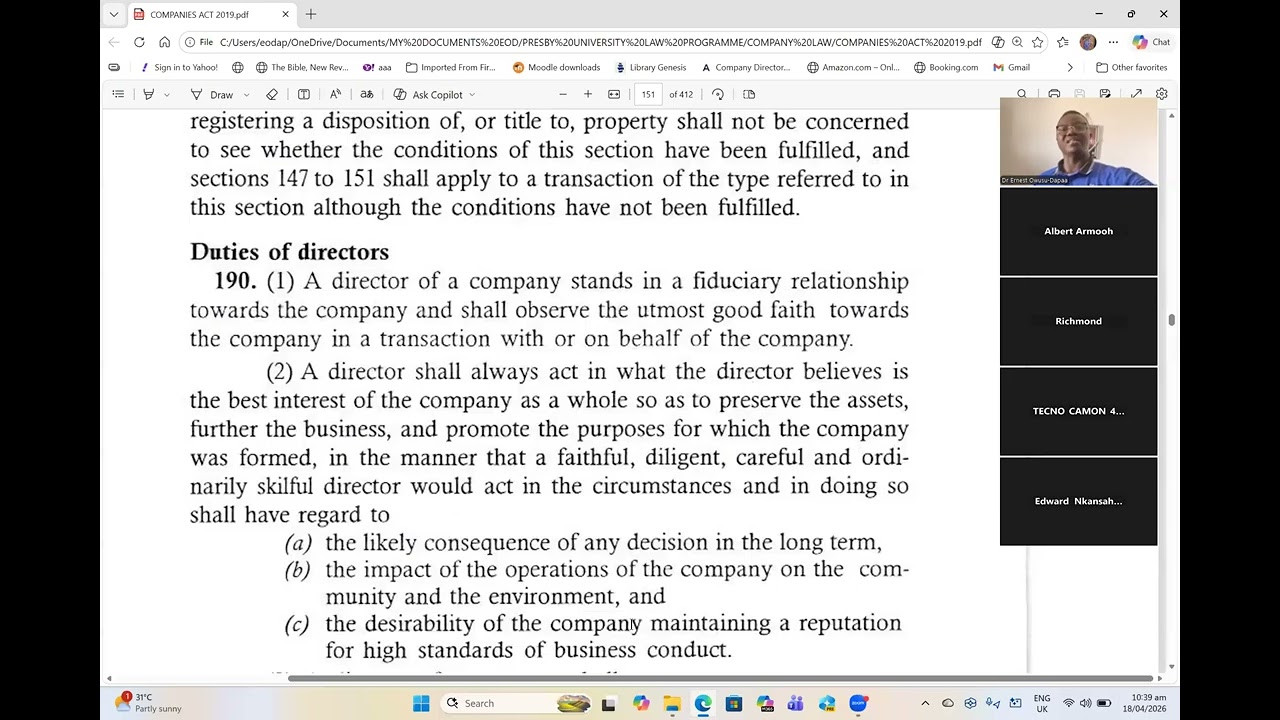
DUTIES OF DIRECTORS – Part 2 This lecture examines the legal framework governing directors’ duties under the Companies Act, 2019 (Act 992). At the core of Ghanaian company law is the principle that directors are fiduciaries of the company. Section 190(1) provides that a director stands in a fiduciary relationship and must act in utmost good faith. This reflects long-established equitable principles seen in cases such as *Aberdeen Railway Co v Blaikie Brothers* and *Regal (Hastings) Ltd v Gulliver*. Directors’ duties may be broadly classified into fiduciary duties, duties of care and skill, and statutory duties. Fiduciary duties emphasise loyalty, while care duties focus on competence and diligence. The duty of utmost good faith is foundational. It requires honesty, loyalty, and avoidance of bad faith. A director must not act for personal benefit, pursue improper purposes, or conceal material information. The duty is strict: liability may arise even where the director acts honestly and the company suffers no loss. It operates as the umbrella duty from which other obligations derive. Closely related is the duty to act in the best interest of the company under section 190(2). This duty has both subjective and objective elements. Directors must act in what they honestly believe to be in the company’s interest, but also meet the standard of a faithful, diligent, and ordinarily skilful director. The phrase “company as a whole” refers to the corporate entity, not individual shareholders. Modern Ghanaian law adopts a broader approach by requiring consideration of long-term consequences, environmental impact, and corporate reputation. The duty to exercise independent judgment under section 190(5) ensures that directors act as decision-makers, not mere agents. A director must apply his own mind and cannot blindly follow instructions from shareholders, political authorities, or dominant figures. While reliance on professional advice is permissible, it must not amount to abdication of judgment. The duty of care, skil
You May Also Like
- 1

Albumbackdrop electro
YO SOUND · 3,633 plays
- 2
AlbumFree Movement
TruckerJoe · 9,248 plays
- 3
AlbumFrequency of the Void
AFRO HOUSE AUTHORITY · 6,774 plays
- 4
AlbumThe Best of Jewel Akens
Jewel Akens · 7,916 plays
- 5
AlbumSynthology 1
Raaya · 1,931 plays
- 6
AlbumRap - Rock - Reggae
Pretty Much Cousins · 8,278 plays
- 7
AlbumBoom Boom Beat
LoudForgeMusic · 7,878 plays
- 8
AlbumDolate Eshgh (The State of Love)
Shahryar Rumi · 6,457 plays
- 9
AlbumMKascity
MKascity · 11,799 plays
- 10
AlbumEternal Spiritual Luminance
Maestro Blink · 6,546 plays
- 11
AlbumAdro Music
Adro Music · 8,355 plays
- 12
AlbumSissification
Anglo-Saxon Andrea · 3,741 plays