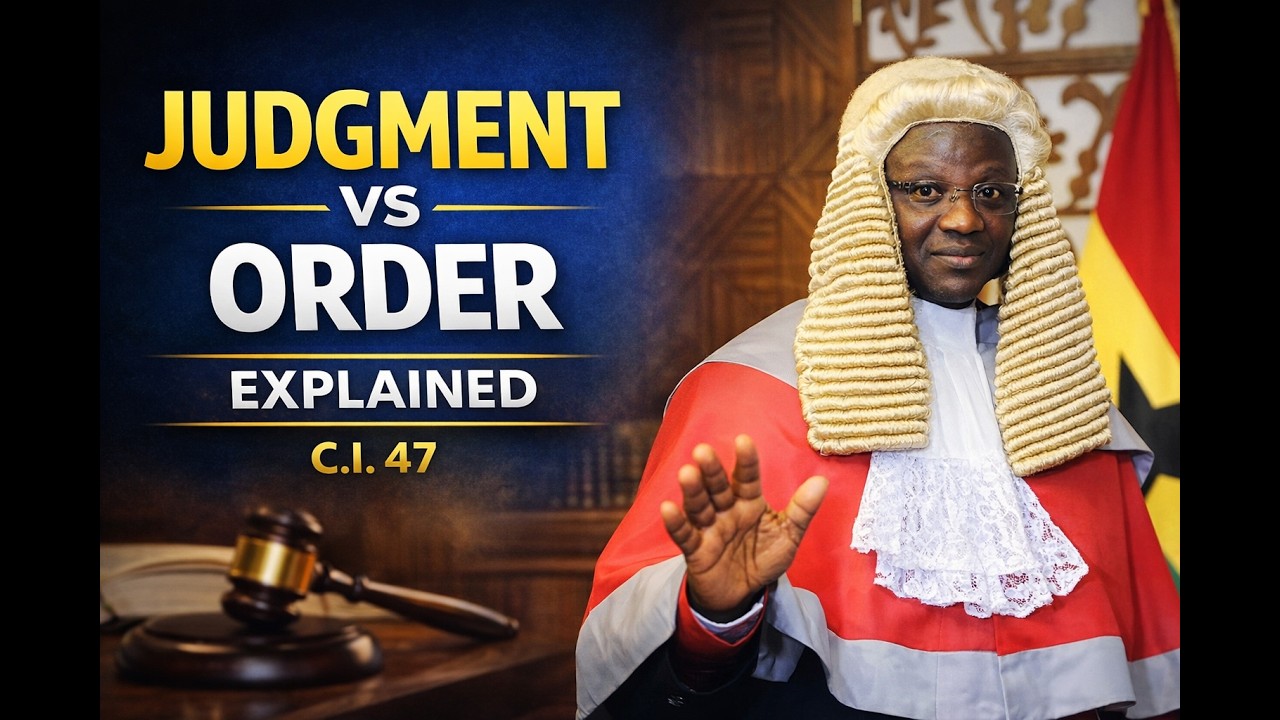
CIVIL PROCEDURE-JUDGMENTS AND ORDERS EXPLAINED | CIVIL PROCEDURE (C.I. 47 GHANA)
25:22 · 9,687 plays
From the album GHANA LAW TV
Description
In this lecture, I explain Judgments and Orders in Civil Procedure under C.I. 47 (Ghana). This topic is fundamental to understanding how courts determine rights and how decisions are enforced. The lecture covers: Meaning of judgment, order, and ruling Differences between judicial decisions Declaratory judgments and their legal effect Time limit for delivery of judgment Judgments against the State (Act 555) Enforcement of judgments Entry of judgment as a condition for execution Practical steps in civil litigation This lecture is essential for: LLB and LLM students Ghana School of Law candidates Practising lawyers and judges Anyone studying civil procedure and litigation The discussion is grounded in: C.I. 47 (Order 41) State Proceedings Act, 1998 (Act 555) Leading Ghanaian case law 👉 Subscribe for more lectures on Civil Procedure, Evidence, and Ghanaian Law ---. A court’s decision may take three principal forms: judgment, order, and ruling. Understanding the distinction between these forms is essential to appreciating how courts determine rights and regulate proceedings. A judgment is the final determination by the court of the rights and obligations of the parties. It is delivered after the hearing of evidence, addresses of counsel, and evaluation of both facts and law. It represents the culmination of the trial process, where the court applies the law to the established facts. An order, by contrast, is a directive issued by the court requiring a party to do or refrain from doing something. Orders may be interlocutory, made during the course of proceedings, or final, disposing of the case. A ruling, on the other hand, is a decision on an interlocutory matter, such as admissibility of evidence or procedural objections. Thus, rulings regulate the process, orders enforce directions, and judgments determine substantive rights. A particularly important category is the declaratory judgment. A declaratory judgment merely declares the rights or legal position of the parties without granting coercive relief.
You May Also Like
- 1

AlbumFire Fight
Fire Fight · 523 plays
- 2
AlbumConspiracy Theories
Spotify Studios... · 523 plays
- 3
AlbumHappiness & Authority
Mid Youth Crisis · 4,502 plays
- 4
AlbumSantana
Santana · 174 plays
- 5
AlbumOLD SKOOL IS V
VIGILANT · 1,918 plays
- 6
AlbumAzain
Azain · 11,339 plays
- 7
AlbumMalou Boysen
Malou Boysen · 8,367 plays
- 8
AlbumBeulah
Beulah · 4,491 plays
- 9
AlbumManChip
ManChip · 7,658 plays
- 10
AlbumLeisure Time
T. Texas Tyler · 6,135 plays
- 11
AlbumPARTY
laemitock · 3,320 plays
- 12
AlbumDivine Rocks
Stack Culture · 4,842 plays