Description
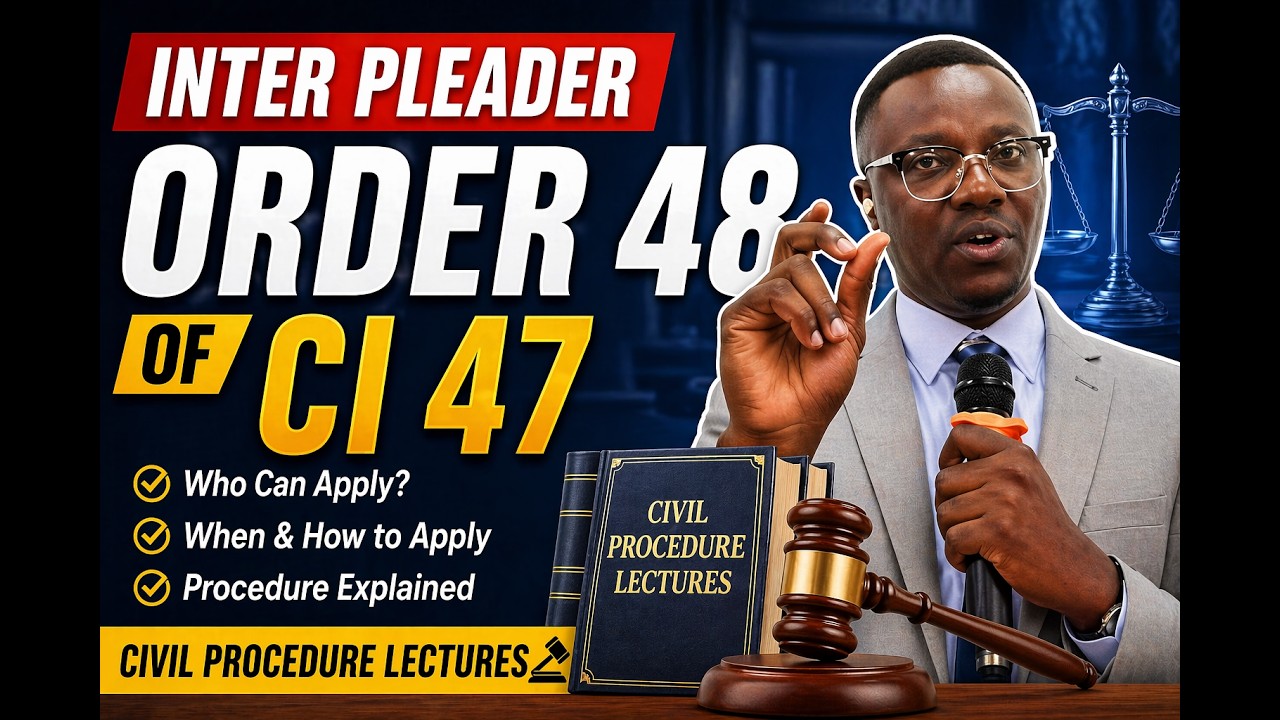
INTER-PLEADER UNDER ORDER 48 OF C.I. 47 This lecture provides a clear and practical exposition of Interpleader proceedings under Order 48 of the High Court (Civil Procedure) Rules, 2004 (C.I. 47). Interpleader is one of the most important procedural devices in civil litigation, particularly in execution proceedings, where competing claims arise over the same subject matter. At its core, interpleader is designed to protect a neutral party who is exposed to **multiple liability**. Typically, this is a person who holds property, money, or goods but does not claim ownership, and yet faces rival claims from two or more parties. Rather than risk double liability, the law allows that person to invoke the court’s jurisdiction to determine who is truly entitled. 1. WHEN INTERPLEADER ARISES Under Order 48, a person may apply for interpleader relief where: * The applicant is under liability in respect of **debt, money, or goods**; and * There are two or more adverse claimants asserting competing rights to the same subject matter. The Order also extends to situations involving court officers such as Registrars or bailiffs particularly in execution processes where property has been seized and a third party asserts ownership. 2. NATURE AND PURPOSE OF INTERPLEADER The essence of interpleader is neutrality. The applicant is not asserting a claim but is instead saying: “I hold this property, but I do not know to whom it belongs. Let the Court decide.” The procedure therefore: * Prevents multiplicity of suits * Avoids double liability * Promotes judicial efficiency * Ensures fairness among competing claimants 3. MODE OF APPLICATION (RULE 2) An interpleader application is commenced by **motion on notice to the claimants**. At the hearing, the Court may direct the claimants to appear and state the particulars of their claims, and either maintain or relinquish them. 4. APPLICATION BY A DEFENDANT (RULE 3) Where the applicant is already a defendant in an action, the application may be made **after service of the writ**, an
You May Also Like
- 1

AlbumA L P H A
Duke & Dean · 6,177 plays
- 2
AlbumThe Darker Side of Nonsense
Dry Kill Logic · 2,442 plays
- 3
AlbumBedtime Without Battles: Gentle Routines that Turn Chaotic Evenings into Calm, Predictable Family Time
174 plays
- 4
AlbumBetween Classic and Romantic, Vol. 2
Federica Claudia Maggiore · 10,338 plays
- 5
AlbumScrewbar Radio
7,195 plays
- 6
AlbumWhen the Wolf Got Matched
1,046 plays
- 7
AlbumCleisson Cirqueira
Cleisson Cirqueira · 3,213 plays
- 8
AlbumBette Radio
Tabloyd · 349 plays
- 9
AlbumBarry Marrow
Barry Marrow · 174 plays
- 10
AlbumLevitation
Hawkwind · 7,353 plays
- 11
AlbumMardi Gras Tape Volume 2
Mardi Gras Tapes · 10,177 plays
- 12
AlbumChili π
Chili π · 3,651 plays