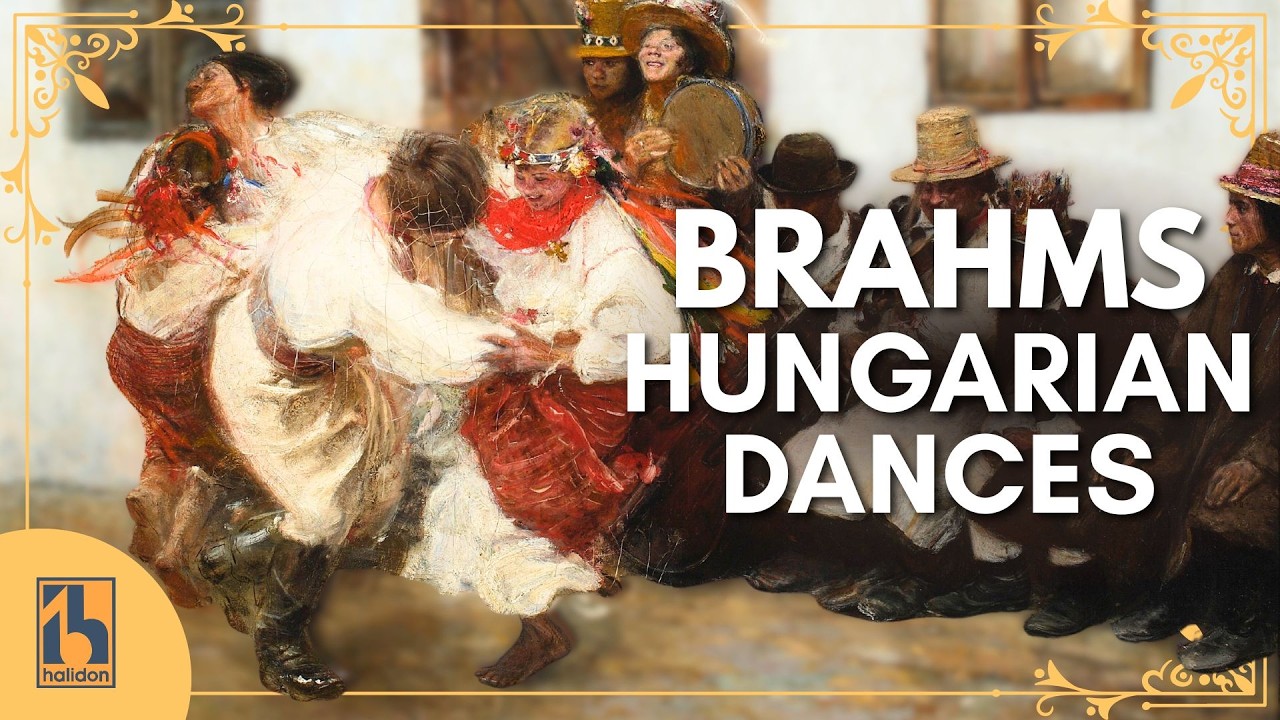
Brahms: Hungarian Dances for Piano Four Hands | Hector Moreno & Norberto Cepelli
52:18 · 5,884 plays
From the album Royal Music
Description
🎧 Listen to the album on Spotify: https://open.spotify.com/intl-it/album/1NNnzzEDytKL9SPc106uw1 🎵Listen to our "Best of Mendelssohn" video: https://youtu.be/xGPA0gjxga4 🎼Listen to ORA's "Ein Deutsches Requiem Requiem" live concert recording: https://youtu.be/1PTFKzKoRAw These recordings are available for sync licensing in web video productions, corporate videos, films, ads and music compilations. For further information and licensing please contact info@halidononline.com. ☕ If you like what we do and would like to support us, you can now buy us a coffee: https://www.buymeacoffee.com/halidonmusic. Donations will go towards keeping the YouTube channel going and funding new recording sessions with our amazing team of artists. Thank you! 🙏 Johannes Brahms composed his 21 Hungarian Dances between 1869 and 1880, originally writing them as light entertainment for piano four hands — the kind of music made for bourgeois drawing rooms. They were later orchestrated and arranged for many different ensembles, becoming some of the most beloved and commercially successful works of his career. The dances draw heavily on Hungarian folk music and the Romani style, especially the csárdás — a tradition Brahms knew well from his travels and his close collaboration with Hungarian violinists. Rather than simple transcriptions, these are original reworkings: he reimagined folk melodies and themes by other Hungarian composers, enriching them with lush harmonies, syncopated rhythms, and striking contrasts between brooding slow sections and explosive, dance-driven finales. Each piece is short — roughly one to five minutes — and follows a characteristic arc: a slow, melancholic opening that suddenly erupts into a frantic, irresistible dance rhythm. The most famous are Nos. 1 and 5, where a clear, memorable theme transforms into a burst of rhythmic energy that captures the festive, uninhibited spirit of Hungarian dance at its best. Artwork: "Ukrainian Folk Dance" by Teodor Axentowicz, 1895 Tracklist: 00:00:00 Hungarian Dances: I. Al
You May Also Like
- 1

AlbumTukko21 Radio
523 plays
- 2
AlbumSecrets of Millbrook High [english]
349 plays
- 3
AlbumSummer House Music Mix 2024
Summer Deep House · 1,570 plays
- 4
AlbumBEETHOVEN: PIANO SONATA No. 7; PIANO SONATA No. 15 PASTORAL; PIANO SONATA No. 32
Edwin Fischer · 6,586 plays
- 5
AlbumLivin The Life
OK!DYNAMITE · 7,057 plays
- 6
AlbumThe Identity Radio
174 plays
- 7
AlbumLove Me Like You Do
174 plays
- 8
AlbumLet Me Bleed
Kiss the Tiger · 4,083 plays
- 9
AlbumKing Kool Radio
Dan Donovan · 5,401 plays
- 10
AlbumНеизбежное принимать равнодушно
Cycle Sadi · 7,589 plays
- 11
AlbumFool's Gold
Karol XVII · 5,294 plays
- 12
AlbumApril
2009 · 6,497 plays