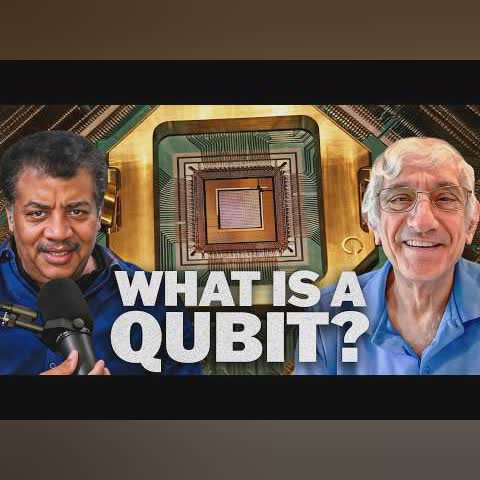
An Interview with the Winner of the 2025 Nobel Prize in Physics, John Martinis
StarTalk · 57:36 · 3 741 прослушиваний
Из альбома StarTalk Podcast
Описание
New cadets. New era. Infinite possibilities. Catch a new episode of Star Trek: Starfleet Academy every Thursday starting Jan. 15th on Paramount+. Can quantum tunneling occur at macroscopic scales? Neil deGrasse Tyson and comedian Chuck Nice sit down with John Martinis, UCSB physicist and 2025 Nobel Prize winner in Physics, to explore superconductivity, quantum tunneling, and what this means for the future of quantum computing. What exactly is macroscopic quantum tunneling, and why did it take decades for its importance to be recognized? We’ve had electrical circuits forever, so what did Martinis discover that no one else saw? If quantum mechanics usually governs tiny particles, why does a superconducting circuit obey the same rules? And what does superconductivity really mean at a quantum level? How can a system cross an energy barrier it doesn’t have the energy to overcome? What is actually tunneling in a superconducting wire, and what does it mean to tunnel out of superconductivity? We break down Josephson Junctions, Cooper pairs, and other superconducting lingo. Does tunneling happen instantly, or does it take time? And what does that say about wavefunction collapse and our assumptions about instantaneous quantum effects? Learn what a qubit is and why macroscopic quantum effects are important for quantum computing. Why don’t quantum computers instantly break all encryption? How close are we to that reality, and what replaces today’s cryptography when it happens? Is quantum supremacy a scientific milestone, a geopolitical signal, or both? Plus, we take cosmic queries from our audience: should quantum computing be regulated like nuclear energy? Will qubits ever be stable enough for everyday use? Will quantum computers live in your pocket or on the dark side of the Moon? Can quantum computing supercharge AI, accelerate discovery, or even simulate reality itself? And finally: if we live in a simulation, would it have to be quantum all the way down? Thanks to our Patrons Fran Rew, Shawn Martin, Kyland Holmes
More By StarTalk
- 1

How We’re Trying to Detect Dark Matter Particles, with Katherine Freese
StarTalk · 4 974 прослушиваний · 51:28
- 2
Scientific Martyrs, Life Beyond Our Planet & More! | Cosmic Queries #106
StarTalk · 8 486 прослушиваний · 51:00
- 3
Space Solar Farms, Blue Straggler Stars, & Earth’s Escape Plan | Cosmic Queries #107
StarTalk · 7 598 прослушиваний · 42:21
- 4
Did Life Come From An Asteroid? With Harold Connolly Jr.
StarTalk · 10 409 прослушиваний · 73:39
- 5
Confronting Neil with Our Burning Questions… Yet Again!
StarTalk · 7 353 прослушиваний · 56:24
- 6
The StarTalk Team Has More Questions for Neil | Burning Question Pt. 4
StarTalk · 6 756 прослушиваний · 65:15
- 7
Why We’re Going Back to Venus, with David Grinspoon
StarTalk · 3 370 прослушиваний · 50:55
- 8
The Problem With Uploading Your Consciousness | Cosmic Queries #105
StarTalk · 3 510 прослушиваний · 74:41
- 9
Incoming Asteroids, Moving Black Holes, & More! | Cosmic Queries #104
StarTalk · 174 прослушиваний · 47:33
- 10
Alcubierre Drives, Antimatter Multiverses & More! | Cosmic Queries #103
StarTalk · 8 337 прослушиваний · 48:11
Вам также может понравиться
- 1
АльбомNominee
Nominee · 174 прослушиваний
- 2
АльбомSimone Michelle Celeb
Simone Michelle Celeb · 8 554 прослушиваний
- 3
АльбомStephen Covey
Stephen Covey · 8 886 прослушиваний
- 4
АльбомNGB Baby3
NGB Baby3 · 7 217 прослушиваний
- 5
АльбомAshe Madao
Ashe Madao · 3 462 прослушиваний
- 6
АльбомDrakxi
Drakxi · 4 681 прослушиваний
- 7
АльбомMusic Walkthrough
Video Game Beats · 3 433 прослушиваний
- 8
АльбомThe KEENstrumentals
Young Keen · 8 194 прослушиваний
- 9
АльбомTime Of My Life
The Rubens · 3 613 прослушиваний
- 10
АльбомThe Monster
The God 720 · 8 609 прослушиваний
- 11
АльбомWhat Did You Do?!
Warren Suicide · 7 446 прослушиваний
- 12
АльбомReflection
Eddysss · 7 094 прослушиваний