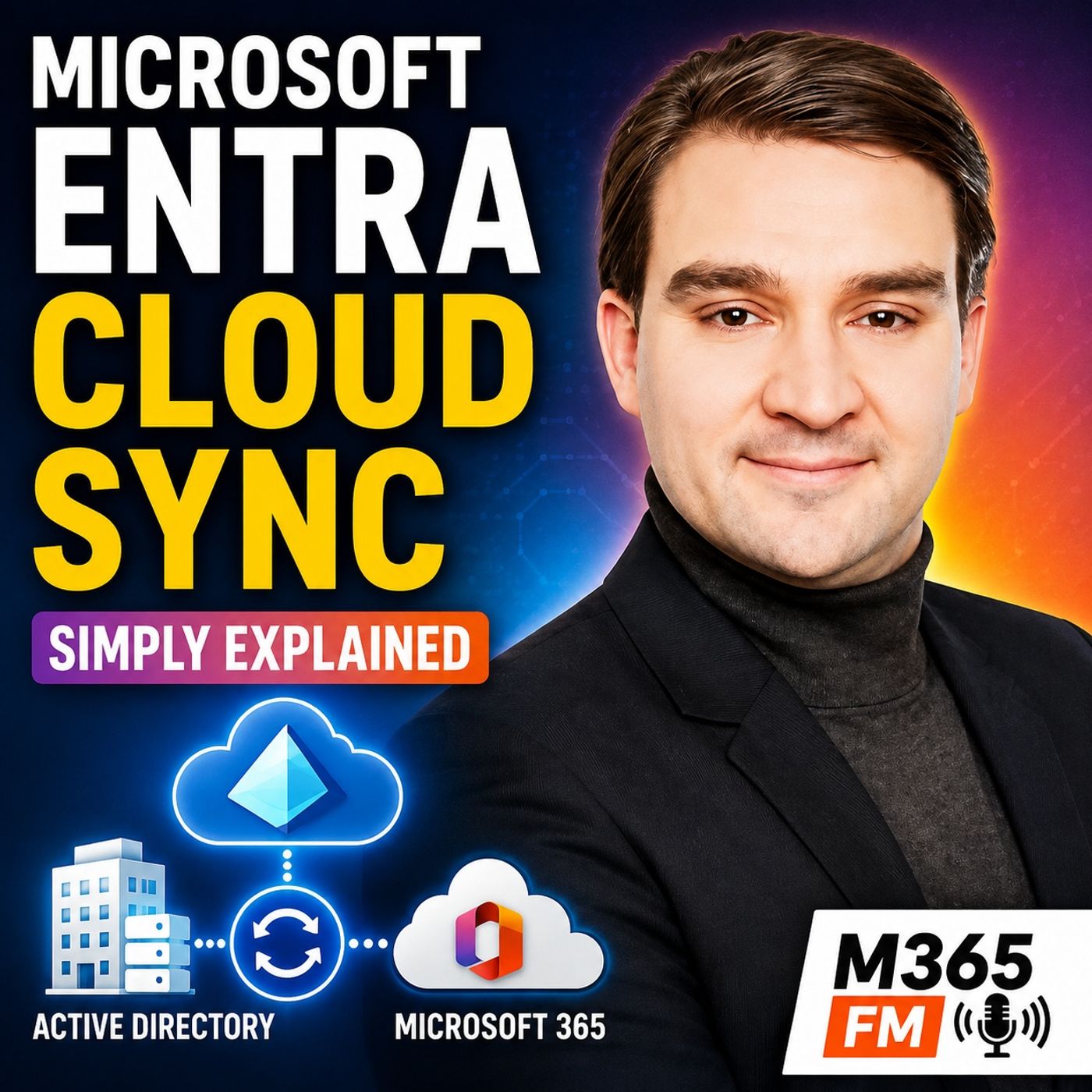
Microsoft Entra Cloud Sync - Simply Explained
Mirko Peters - Founder of m365.fm, m365.show an... · 22:18 · 10,488 plays
Mula sa album M365.FM - Modern work, security, and productivity with Microsoft 365
Paglalarawan
Microsoft Entra Cloud Sync provides organizations with a cloud-managed way to synchronize identities from on-premises Active Directory into Microsoft Entra ID. But how is it different from Microsoft Entra Connect, why would an organization choose it, and what has changed in 2026? In this episode of Microsoft Knowledge Nuggets on M365 FM, we break down Entra Cloud Sync from the basic identity problem through architecture, high availability, scoping, security, hybrid environments, and the decision between Cloud Sync and Entra Connect.WHY IDENTITY SYNCHRONIZATION STILL MATTERSMany organizations still maintain employee identities inside Active Directory while their employees increasingly work in Microsoft 365. A new employee might be created in the local directory but immediately need Microsoft Teams, Exchange Online, SharePoint, OneDrive, and other cloud applications. Without synchronization, IT effectively has two identity environments to maintain.Identity synchronization connects those worlds. Changes to an employee's identity can begin in Active Directory and then flow into Microsoft Entra ID instead of requiring administrators to maintain two independent accounts. This becomes especially important when employees join the company, change departments, receive different permissions, change passwords, or leave the organization.THE TRADITIONAL ENTRA CONNECT MODELMicrosoft Entra Connect has traditionally handled this connection by running a synchronization engine inside the organization's network. It reads Active Directory, processes synchronization rules locally, maintains its own local components, and sends approved identity changes to Microsoft Entra ID.That architecture provides considerable flexibility, particularly for organizations with sophisticated synchronization requirements. But flexibility also creates operational responsibility. The synchronization server must be maintained, patched, monitored, understood, and incorporated into disaster-recovery planning.If the synchronization infrastructure becomes unav
More By Mirko Peters - Founder of m365.fm, m365.show an...
- 1

Dynamics 365 Contact Center - Simply Explained
Mirko Peters - Founder of m365.fm, m365.show an... · 9,637 plays · 20:21
- 2
Beyond Copilot: Building AI That Works in the Real World with Azure AI Foundry and Agentic AI for Frontline Workers with Fergus Kidd [MVP]
Mirko Peters - Founder of m365.fm, m365.show an... · 12,119 plays · 60:28
- 3
Dynamics 365 Customer Insights Journeys - Simply Explained
Mirko Peters - Founder of m365.fm, m365.show an... · 7,454 plays · 20:12
- 4
Microsoft Entra Domain Services - Simply Explained
Mirko Peters - Founder of m365.fm, m365.show an... · 9,057 plays · 18:11
- 5
AlbumM365.FM - Modern work, security, and productivity with Microsoft 365
Mirko Peters - Founder of m365.fm, m365.show an... · 4,164 plays
- 6
Your Copilot Has No Memory — Why RAG Fails and LLM Wiki Fixes It
Mirko Peters - Founder of m365.fm, m365.show an... · 3,092 plays · 54:58
- 7
PowerPoint Like a Pro- Hidden Features, Corporate Templates & Copilot with Fiona Walsh [MVP]
Mirko Peters - Founder of m365.fm, m365.show an... · 7,074 plays · 62:21
- 8
Power Platform Governance Without Killing Innovation: Security, DLP, Environments & Citizen Development with Michael Roth [MVP]
Mirko Peters - Founder of m365.fm, m365.show an... · 10,497 plays · 63:15
- 9
Microsoft Cloud PKI - Simply Explained
Mirko Peters - Founder of m365.fm, m365.show an... · 9,146 plays · 18:44
- 10
From Demo to Production- Building Enterprise AI Agents That Actually Work with Microsoft Copilot Studio with Elliot Margot [MVP]
Mirko Peters - Founder of m365.fm, m365.show an... · 1,740 plays · 64:55
Baka Magustuhan Mo Rin
- 1
AlbumJordan Ryan
Jordan Ryan · 9,237 plays
- 2
AlbumBlour Radio
Manic Street Preachers · 9,936 plays
- 3
AlbumNadine Norell
Nadine Norell · 5,824 plays
- 4
Albumghst11
ghst11 · 6,597 plays
- 5
AlbumVictory isch Victory
Nur Der BVM · 6,514 plays
- 6
AlbumUn filo senza fine
Paolo Vallesi · 7,002 plays
- 7
AlbumNOBΛ • CH
NOBΛ • CH · 9,169 plays
- 8
AlbumTodos a Bailar con Laberinto
Grupo Laberinto · 5,191 plays
- 9
AlbumABM DREDGANG PRESENTS ABM STREETWAY YO HUSTLE AND FLOW, MIXTAPE, Vol. 1
ABM STREET · 7,026 plays
- 10
AlbumRecluse EP
Darkxic · 1,720 plays
- 11
AlbumMeco_za
Meco_za · 1,330 plays
- 12
AlbumUncle Flotsam Wants Nostalgia
Wishrugs Van Wishrugger · 7,092 plays